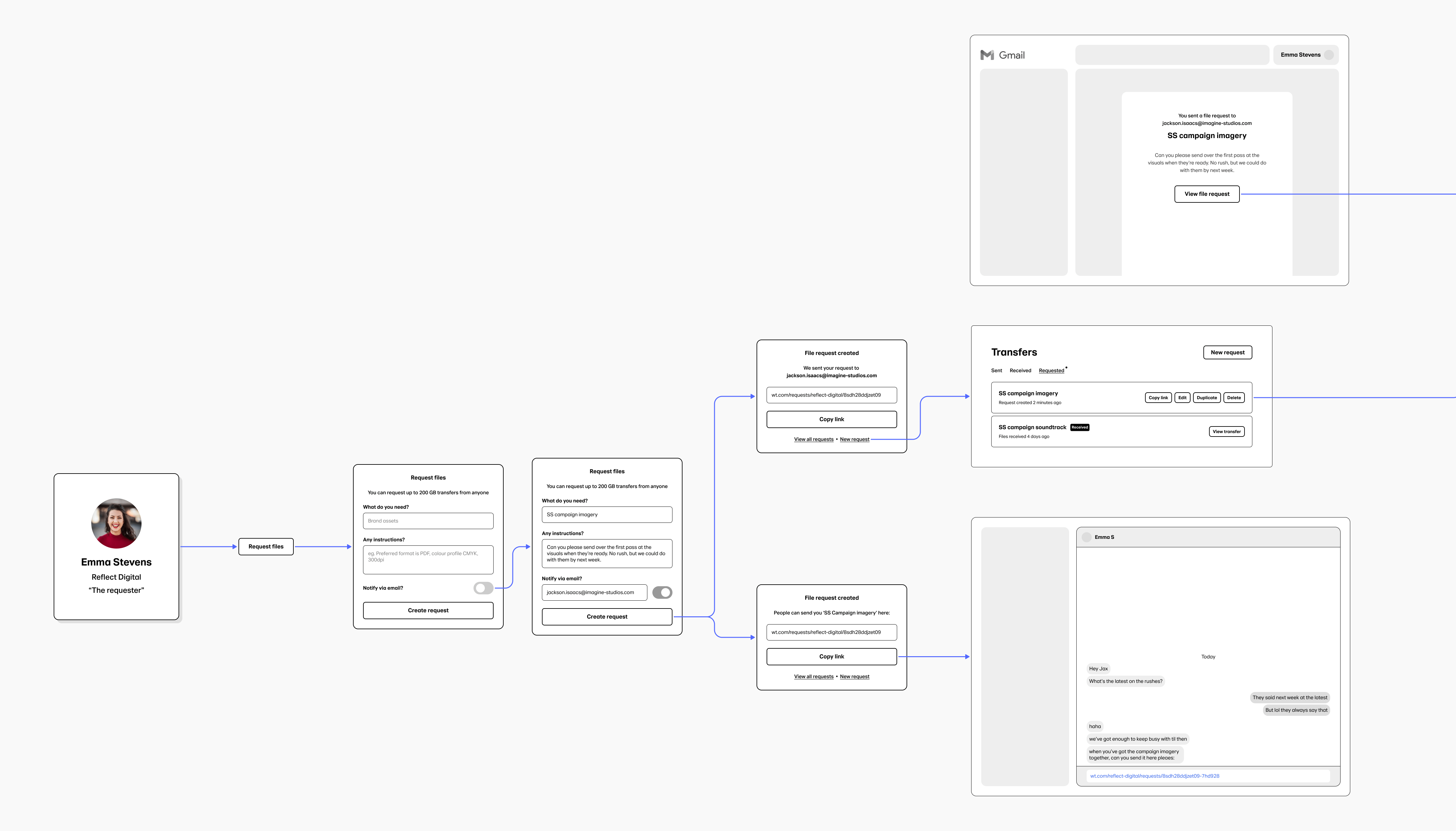
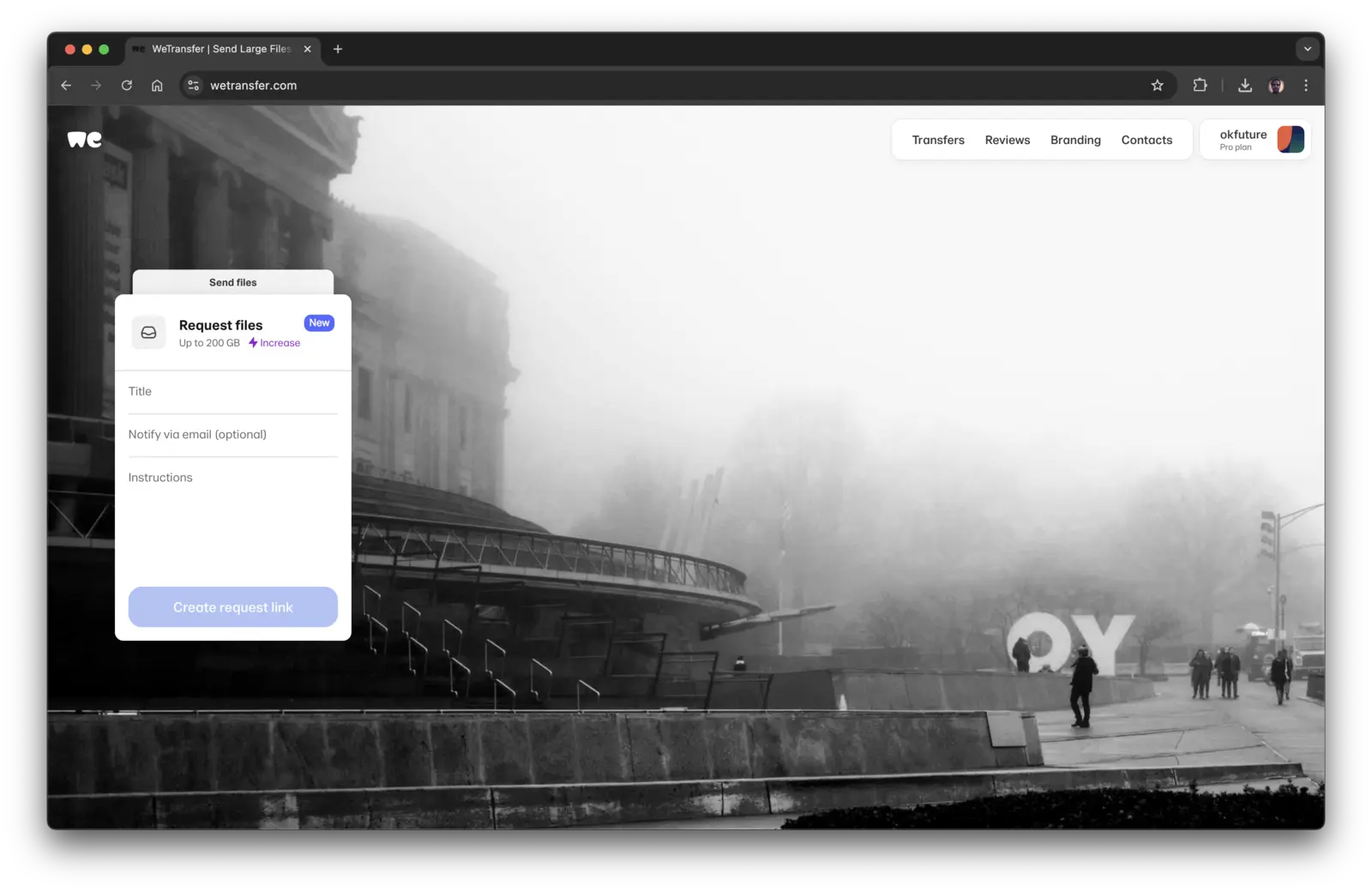
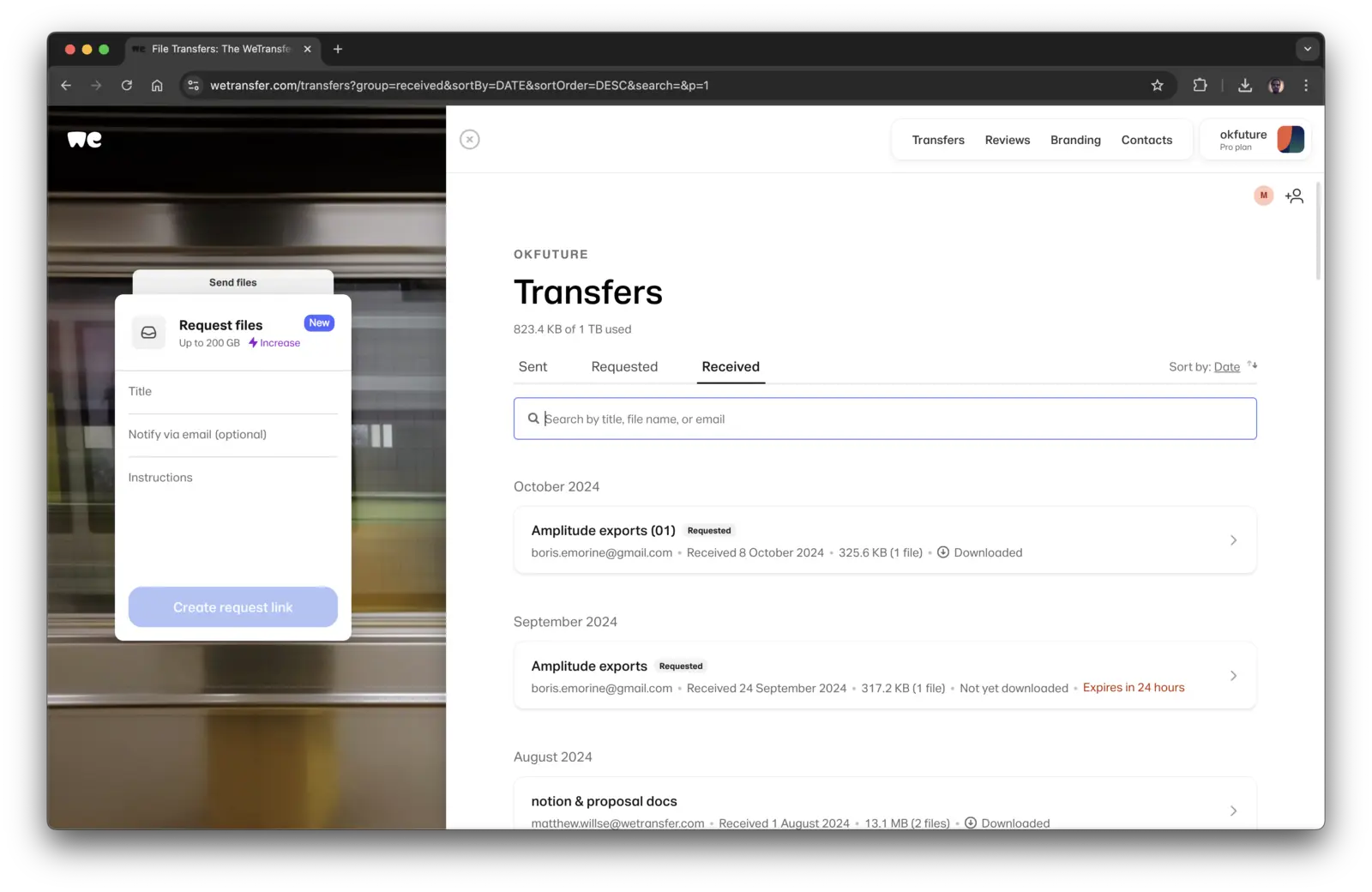
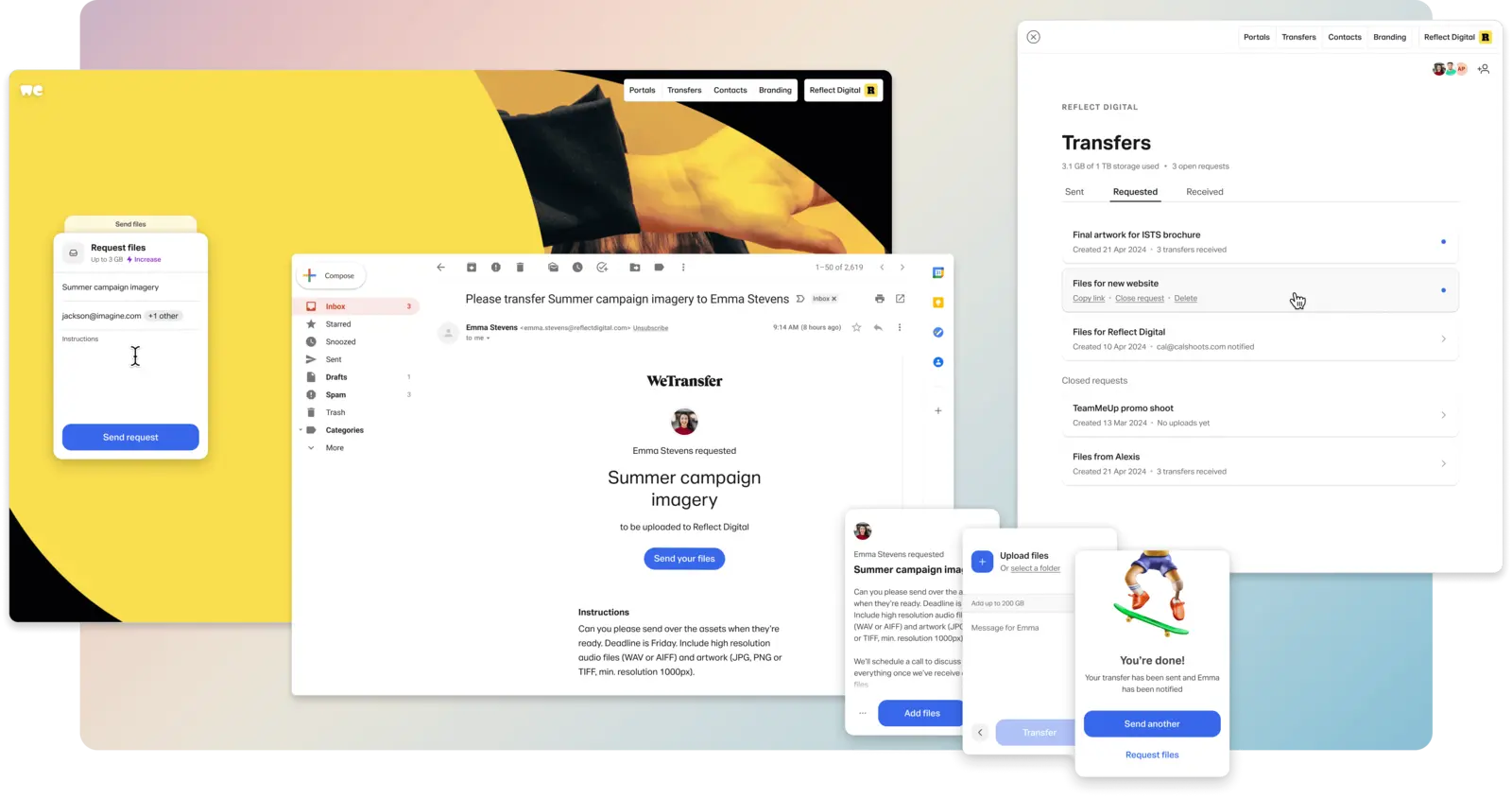
tl;dr - Launched a major feature with big impact on a beloved product that remained largely unchanged for more than a decade. We enabled users a powerful way to request files from anyone on any device. They can guide their audience, track progress, and organize it all. The release greatly reduced new subscriber churn by providing evergreen value, a longtime need for the business.
Impact
New subscribers who tried Requests show 16.7% lower M1 churn rate than other subscribers.
7.0% of existing subscribers exposed to the value prop have been activated.
WeTransfer was acquired midway through our build. I rallied the team to see the project through, for our users and to hone our craft and learning.
Problem
For over a decade, WeTransfer has empowered creative professionals to send media files effortlessly. Each month, 80 million people choose it to transfer files too large, numerous, or complex for email or messaging. They prefer it over cloud storage for its simplicity, flexibility, and cost. Users can send files from any device or OS to anyone globally, with over 600,000 subscribing for pro use.
However, collaboration is not one-way. Print shops and legal professionals need to receive a constant stream of files throughout the day. Creative professionals, in particular, are frequently held back waiting for assets from clients and collaborators. This dependency causes costly delays, disrupts creative workflows, and leads to missed deadlines. It ultimately reduces productivity and increases frustration.
For our users to get their work done efficiently, they rely on others to take action and know how. Our users need a way to provide clear instructions and track the entire process from start to finish.
Hypothesis
If we offer users a simple way to request files, guide their audience, track progress, and organize it all, we will increase user retention and attract more new users.
Validation
Before we developed a solution, I first validated the need and identified existing demand.
Data Insights
I began by analyzing product data to uncover patterns in existing user behavior. This required some creative problem-solving, as our tracking and database were not set up to capture this specific usage.
- We discovered tens of thousands of users had found ways to adapt our product to receive files, rather than just send them. This behavior highlighted a significant unmet need that aligned with known market challenges.
- Bingo: These users were among our most loyal, demonstrating much higher retention and lifetime value (LTV).
A requests feature had big potential to solve a business problem: user churn was high because usage is periodic. Requests could bring enduring value to intermittent subscribers, who essentially pause their subscription between projects that require pro features. - Two primary use cases for Requests emerged: One-to-one scenarios, like agencies receiving files from clients or freelancers, and One-to-many cases, such as print shops or post-production companies receiving bulk file submissions for business orders. We also found many creative use cases, such as a business that enabled their customers to hire a local photographer to document their vacation, all powered by WeTransfer.
- Despite no marketing, dedicated features, or support, this usage to receive files was prevalent among 7% of our subscribers. After modeling the potential impact on retention and conversion, even conservative estimates suggested an opportunity worth nearly $1 million in ARR.
We had found untapped money sitting under our desks.
UXR Insights
We then surveyed hundreds of users and conducted in-depth interviews with a select dozen. We also tested early concept prototypes for clarity, value, and user experience.
- Users had devised workarounds for receiving files, such as posting evergreen links and instructions on their websites or embedding instructions on their WeTransfer wallpaper backgrounds. Agencies created boilerplate emails to guide clients through the process.
- Many users struggled to instruct their audience, often requiring follow-up to clarify expectations.
- Users also had difficulty tracking progress: Who had they requested files from? Who had responded? Which files needed review or further action?
- Both users and remote testers immediately grasped the concept and expressed strong demand for the value it provided.
Design, Spec & Build
The spec, both technical and design, was co-designed with continuous collaboration between product, design, and engineering. A more full write up on this process will follow another day. The full solution was developed like a polaroid coming into focus, first articulating the broad shape and color end-to-end. As details emerged, we discussed, diagramed, prototyped, and tested. The process was lean, iteration was organic and fluid until we were ready to release.